Anthropic filed its S-1 on October 26, 2026, to list on Nasdaq under the ticker ANT (S-1), at a reported valuation of up to $2 trillion (Axios). Trading could begin in mid-November (CNN). For employees, Anthropic IPO taxes will shape every decision that follows.
DGS Capital’s CIO Ashish Sharma explains why concentrated Anthropic stock is risky even when the company is doing well, how tax implications impact the selling decision, and which tax-efficient strategies can help investors diversify. It is written for investors holding Anthropic stock and the advisors who work with them. Throughout, “you” means the investor holding the stock; advisors can read it as “your client.”
Rich on paper, exposed in practice - Why diversifying is the right answer
Anthropic’s IPO will likely turn hundreds of employees into millionaires, many decamillionaires (+$10M), and several centimillionaires (+$100M). For many early employees, one stock will make up almost all their net worth. The same single-stock concentration that created wealth can also erase much of it, fast.
If history is any guide, Anthropic’s stock is more likely to underperform the broader market than it is to outperform. Historically, the typical US stock has lost money over its listing period (SSRN). Why the broader stock market generates positive returns when the typical stock loses money is beyond the scope of this piece.
This is not to say that Anthropic is a bad investment, and certainly not that it is a bad company. The point is that when your wealth is concentrated in a single stock, the prudent answer is always to diversify, regardless of whether you think that company is good, bad, or mediocre.
If your goal is to have the highest chance of exponentially growing your wealth, statistically, concentration is expected to work better than diversification – it’s much more likely that a single company becomes 10x in a year than the whole market goes up 10x. But concentration also carries a much higher risk of permanent capital loss – it’s much less likely that all companies go bankrupt versus one does.
If you win the lottery, you’re unlikely to take your winnings and buy more lottery tickets. Being an early employee at Anthropic is like winning the human capital lottery. The goal now is to protect the enormous wealth you have helped create; it’s time to take some chips off the table.
Whether you hold the stock yourself or advise someone who does, it’s important to first understand why investors with concentrated stock may not want to sell.
Why investors hesitate to sell concentrated stock
Having had hundreds, if not thousands, of conversations with advisors and their clients, I have seen a few consistent themes as to why folks with concentrated stock positions don’t want to sell.
Past performance bias: People end up with a majority of their net worth in a single stock because that company and its stock have done exceptionally well. Anthropic is no exception. At a $2 trillion valuation, it has created generational wealth for many of its employees. And that’s where the bias kicks in: “but it has done so well for me.” It has. And that’s why you have tens, if not hundreds, of millions of dollars in that one company. The goal is to tighten the band of potential future outcomes, and that starts with reducing concentrated stock risk, regardless of how magnificent its past performance has been.
The fear of missing out: This relates to the above, because investors extrapolate past performance and don’t want to miss the next 10x/100x/1000x they think Anthropic will provide. Sure, Anthropic may go from a $2 trillion market cap to $20 trillion. It’s also entirely possible it drops to a $200 billion market cap. I can’t tell you which one is more likely. But think about how you would feel if the stock 10x’d versus if it dropped 90%, and how each scenario would affect your future. If you’re like most people, loss aversion kicks in; you want to avoid the 90% loss outcome, even if it means giving up the 10x upside potential.
Inertia + Tax Aversion: If I gave you $50 million of cash, would you go out and buy $50 million of Anthropic or any one company? Unlikely. Yet when we have $50 million in one stock, we don’t see selling it as the glaringly obvious answer. Part of that is inertia. Instead of making the necessary changes, we choose the path of least resistance: leaving the stock untouched. And much of that investor inertia comes from the tax bill they face. Assuming you are a resident of California, the location of Anthropic’s headquarters, the tax bill is meaningful, especially if taxed at short-term capital gains tax rates.
Anthropic employees won’t have a zero-cost basis, and some may have little to no unrealized gains (for example, from RSUs that vest at IPO). However, if you have a large, unrealized gain and the potential tax cost is holding you back from diversifying, you have tools to diversify today while potentially minimizing or entirely deferring your tax liability.
How can you diversify Anthropic stock without paying taxes today?
Yes, the options below can help employees diversify while deferring tax liability. Each option has its merits, and we have outlined who it may work best for.
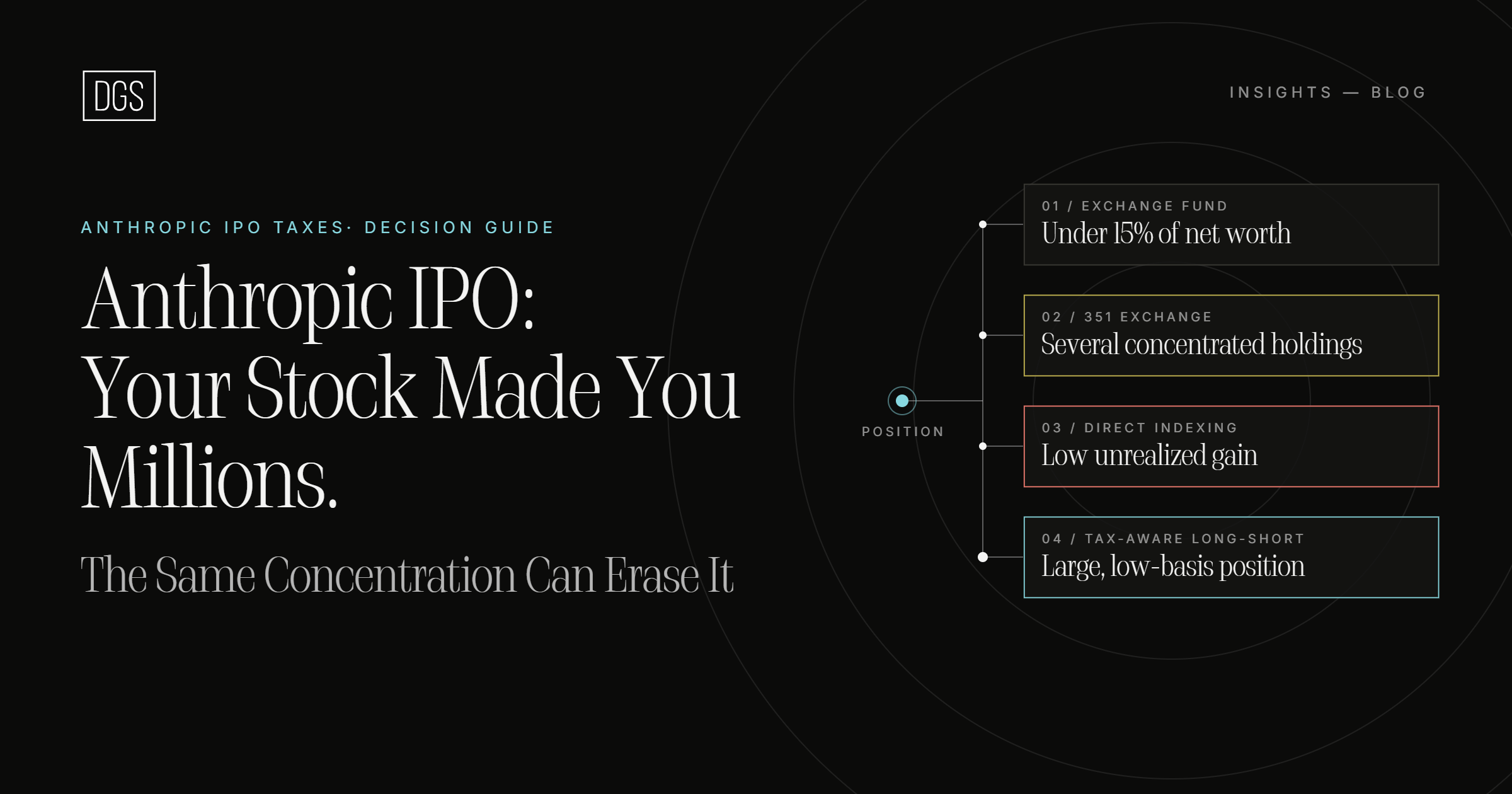
Option 1: Exchange fund – when Anthropic is a smaller part of your net worth
If Anthropic is less than 15% of your liquid net worth, an exchange fund would likely be a suitable option (assuming you meet the required accredited or qualified-purchaser status that exchange funds may require). You can pool your shares with other investors’ stock. After seven years, you receive the basket of stocks the fund holds with the same cost basis as your original investment. The catch is that to reap the diversification and tax benefits, you can’t access the funds for seven years. This is why it works best for smaller position sizes relative to your liquid net worth, because you don’t want a large portion of your liquid net worth to be illiquid.
Tax today: $0, deferred until you sell the basket.
Diversification: Immediate, through the pool.
Equity exposure: 100%
Access to money: Locked for seven years (to achieve tax and diversification benefits).
Option 2: 351 exchange – when Anthropic isn’t your only concentrated stock
For employees who already hold other concentrated stock positions, a 351 exchange allows you to transfer those positions into a newly launched ETF in exchange for ETF shares, generally tax-free under Section 351.
Tax today: $0, deferred until you sell the ETF.
Diversification: Immediate, but only if you bring a diversified portfolio: no stock above 25% of the contributed amount; the top five can’t exceed 50% of the contributed amount.
Equity exposure: 100%
Access to money: Full. The ETF trades daily.
Best for: Investors with several large holdings, not one.
Option 3: Direct indexing – when your Anthropic position has low unrealized gains
For employees with a higher cost basis (smaller unrealized gain percentage), a tax-aware separately managed account, including strategies such as direct indexing, can help offset the tax liability otherwise associated with selling the stock. However, if the unrealized gain is a large share of the position, this approach either defers only part of the tax bill when you sell the whole position or takes much longer to diversify if you want to limit each year’s tax.
Tax today: Partly offset. Most of the gain is still taxed as you sell.
Diversification: Gradual, over many years.
Equity exposure: 100%
Access to money: Full.
Best for: Low unrealized gains.
Option 4: Tax-aware long-short – for large positions with large, unrealized gains
For employees with a large portion of their net worth in Anthropic stock and a low-cost basis, the tax-aware long-short strategy may help diversify while potentially deferring the entire tax liability otherwise associated with the sale. For more details on the mechanics of the strategy, read our Tax-Aware Long-Short Investing Handbook.
Tax today: Little to none, if harvested losses keep pace.
Diversification: Immediate, if timed correctly.
Equity exposure: Fully controllable (0% to 100%)
Access to money: Full.
Best for: Large, low-basis positions that need to diversify fast.
For low unrealized gains, the decision to sell should be straightforward. For smaller position sizes, exchange funds and 351 exchange ETFs may work well. For larger position sizes with large, unrealized gains, the tax-aware long-short strategy may offer the most flexibility.
What should Anthropic employees and their advisors do before shares unlock?
For some holders, the first selling window opens on the first trading day, so the time to set up is now.
Know the cost basis, lot by lot. RSU vesting value, option exercise values, and the impact of share splits.
Read the lockup and trading policy. Know the unlock dates and whether hedging or pledging is allowed.
Pick a target. Decide how much Anthropic you want to own in two years, not just what to sell first.
Determine which diversification strategy works best for you or your client. The flowchart above is meant to serve as a guide, but each investor’s preferences and requirements will impact this decision.
This article is for education only and is not tax, legal, or investment advice. Figures use 2026 top marginal rates and a simplified example. Work with a CPA and financial advisor before acting. DGS Capital is not affiliated with Anthropic. Short selling and margin involve risk, including the potential for losses greater than the amount invested. Tax outcomes vary and tax law may change. SEC registration does not imply a certain level of skill or training.
Related Case Studies
Anthropic IPO: Your Stock Made You Millions. The Same Concentration Can Erase It
Guides
The Tax-Aware Long-Short Investing Handbook
Guides
The toolkit
Frequently Asked Questions:
01
When does the Anthropic lockup end?
In stages. Officers, directors, and certain employees can sell up to 10% of their locked-up shares on the first trading day, up to 35% more after full-year 2026 results, and the rest by the earlier of Q1 2027 results or day 180 (S-1). Co-founders and holders of more than 0.5% stay locked up longer. Check your own lockup agreement.
02
How are Anthropic IPO shares taxed?
In two steps. First, RSUs are taxed as ordinary income when they vest at the IPO, and options are taxed when you exercise or sell, depending on the type. Second, any growth after that is a capital gain: taxed at ordinary income rates if you sell within 12 months, at lower long-term rates after that.
03
Do I have to pay capital gains tax on RSUs?
Only on growth after vesting. Your cost basis is the share value on vesting day, so selling at that price means no capital gain. Anything above it is a capital gain; anything below it is a capital loss.
04
What is considered a concentrated stock position?
A common heuristic is 10% or more of your net worth in a single stock. Many early Anthropic employees are well above that, often holding most of their wealth in one company that also pays their salary. Learn more about our concentrated stock expertise.
05
Can I diversify a concentrated stock without paying taxes today?
Selling and reinvesting normally triggers tax. A few tools can defer it: an exchange fund, a 351 exchange, direct indexing, and a tax-aware long-short strategy. Each works differently and choosing the right one depends on your cost basis and how much of your net worth is in Anthropic.
06
What is a 351 exchange?
A generally tax-free swap of stocks you own for shares of a newly launched ETF, under Section 351 of the tax code. It does not work for a single stock: what you contribute must already be diversified, with no stock above 25% and the top five no more than 50%.
07
What are the pros and cons of exchange funds?
The main advantage is instant diversification with no tax on the swap. The drawbacks include a seven-year lockup, caps on how much of any single stock can be accepted, limited control over the underlying strategy or equity exposure, and at least 20% held in illiquid assets such as real estate.
08
How does a tax-aware long-short strategy work?
A manager holds stocks expected to rise and short positions in stocks expected to fall. Because one side is usually losing, it can harvest tax losses in any market and use them to offset gains as it sells your concentrated stock. It uses standard tax rules, including wash-sale rules, and defers tax rather than eliminating it.
09
What are the risks of a tax-aware long-short strategy?
Short selling and leverage can magnify losses, and results depend on markets and the manager’s execution. Tax benefits are not guaranteed: they depend on realized losses, wash-sale rules, and your tax situation, and tax law can change. The strategy defers tax rather than eliminating it, so it needs careful monitoring.
10
Who should consider a tax-aware long-short strategy for Anthropic stock?
It tends to fit holders whose Anthropic position is large (relative to their net worth), have a large amount of unrealized gains, and want to diversify sooner rather than later. It is not right for everyone.
Get an advisory call directly from our CIO.
Bring a real client situation you’re working on - concentrated stock, a legacy portfolio, a complex tax picture, or a cash implementation. We'll workshop it on a 30-minute call and follow up with a detailed implementation plan.
Thank you! Your submission has been received!
Oops! Something went wrong while submitting the form.