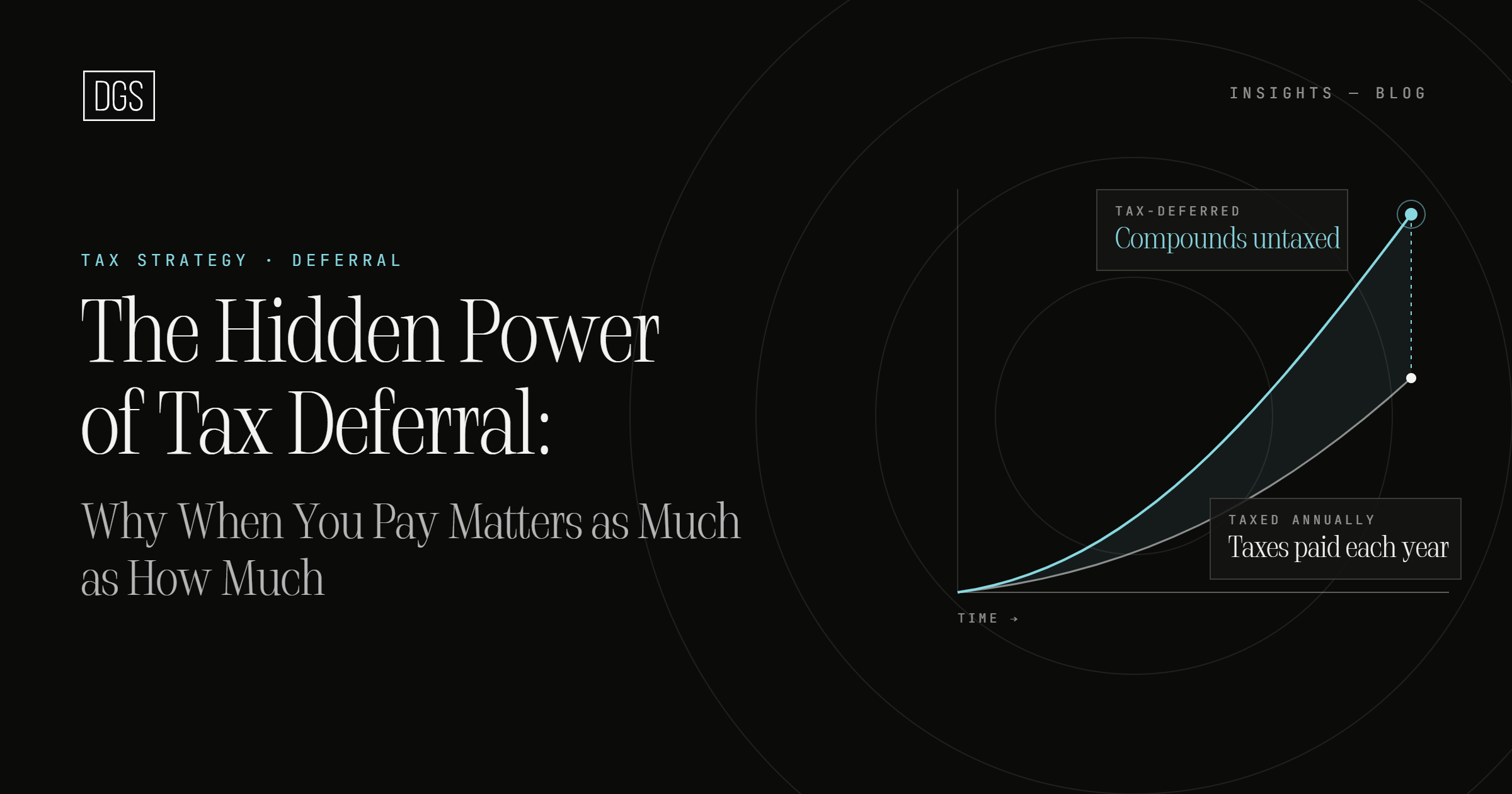
Most investors focus on the tax rate they pay. Few think about when they pay it. Because of compounding, delaying a capital gains tax bill can be worth a surprising amount, even if the tax is eventually paid.
Where do the losses that fuel tax deferral come from?
Tax deferral often starts with realized losses, which can offset gains elsewhere in your portfolio. Typically, the two approaches outlined below can generate them.
Long-only separately managed accounts (SMAs). Instead of owning a fund or an ETF, you own the individual securities directly. Even in a rising market, individual stocks move differently, and some will fall below their purchase price. A tax-aware manager can sell those positions, realize the losses, and reinvest in similar holdings to keep the portfolio’s risk profile intact. You can then offset those losses against gains from other sources, such as a business sale, a concentrated stock position, or a real estate sale.
Long-short tax-aware strategies. These add short positions to the mix, which creates more opportunities to realize losses. Shorts that rise in value can be closed at a loss, and the strategy has more flexibility to harvest losses in both directions. The result is often faster, higher-volume realized losses relative to the standard long-only tax-managed approach. DGS Capital’s Tax-Aware Long-Short Investing Handbook walks through how these strategies work in practice.
Both approaches typically lower the cost basis of the portfolio, so the tax is generally deferred rather than eliminated. The rest of this post shows why deferral alone can be so valuable.
The numbers below are hypothetical, for illustration only. We assume an 8% annual return over 10 years (a growth factor of 2.1589), and no dividends, transaction costs, or other fees.
Pay taxes now vs. defer taxes.
Suppose you have a $1,000,000 capital gain taxed at 35%.
- Pay taxes now: You realize the gain, pay $350,000 in tax, and invest the remaining $650,000.
- Pay taxes later: Realized losses offset the gain, so you keep the full $1,000,000 invested and defer the tax.
| Year | Pay Now | Defer Taxes | Difference |
|---|
| 0 | $650,000 | $1,000,000 | $350,000 |
| 5 | $955,063 | $1,469,328 | $514,265 |
| 10 | $1,403,301 | $2,158,925 | $755,624 |
The deferred portfolio starts with $350,000 more working for you, and that money earns returns that, in turn, earn returns (the power of compounding). After 10 years, the gap has more than doubled, from $350,000 to about $756,000.
The apples-to-apples comparison: what happens when you liquidate?
Deferral isn’t the same as avoidance, so let’s be fair to the “pay taxes first, then invest” portfolio and liquidate both at year 10, assuming a 35% tax rate on gains.
- The Pay Now portfolio has a cost basis of $650,000, so only $753,301 of unrealized growth is taxed.
- The Defer Taxes portfolio has a cost basis of zero, so the entire $2,158,925 is taxable.
| Metric |
Pay Now |
Defer Taxes |
| Value at Year 10 | $1,403,301 | $2,158,925 |
| Tax at liquidation (35%) | $263,655 | $755,624 |
| After-tax wealth | $1,139,646 | $1,403,301 |
Even after paying the full deferred tax bill, the “pay later” investor ends up with about $263,655 more (about 40% of the $650,000 invested in the “Pay Now” portfolio). The deferred tax acted like an interest-free loan from the government, and you kept the investment returns on it for ten years.
What if your tax rate is lower in the future?
Now assume your rate falls from 35% today to 20% when you liquidate, because of lower income (marginal rate arbitrage), a move to a lower-tax state (geography arbitrage), or realizing long-term capital gains instead of short-term capital gains (tenor arbitrage). The “pay now” investor has already locked in the 35% rate.
| Year |
Pay Now |
Pay Later (35%) |
Pay Later (20%) |
| Value at Year 10 | $1,403,301 | $2,158,925 | $2,158,925 |
| Tax at liquidation | $263,655 | $755,624 | $431,785 |
| After-tax wealth | $1,139,646 | $1,403,301 | $1,727,140 |
| Vs. pay now | | +$263,655 (+40%)1 | +$587,494 (+90%)1 |
1 The percentage difference is based on the initial invested value of $650,000 in the ‘Pay Now’ scenario
Deferral gives you flexibility. If rates fall, you can capture the benefit, and if they stay the same, you still come out ahead. Of course, rates could also rise, and future tax rates are uncertain, so weigh that in any decision.
Magnifying the advantage with a step-up in basis or charitable giving
The examples above assume you eventually sell. A step-up in basis or funding charitable donations with appreciated securities can help avoid long-term capital gains entirely.
Step-up in basis at death. Under current law, assets held at death generally receive a new cost basis equal to their market value, so the embedded gain is never taxed. If neither portfolio is ever sold:
| Metric |
Pay Now |
Defer Taxes |
| Value at Year 10 | $1,403,301 | $2,158,925 |
| Tax at liquidation (35%) | $0 | $0 |
| After-tax wealth | $1,403,301 | $2,158,925 |
The deferral advantage grows to $755,624 (about 116% of the $650,000 invested in the “Pay Now” portfolio) because the deferred tax bill effectively never comes due.
Gifting appreciated securities to charity. Donating appreciated securities (generally those held more than a year) instead of cash lets you avoid the capital gains tax and, in most cases, still deduct the full market value, subject to IRS limits. The lower the basis, the larger the tax avoided. Gifting the stock directly avoids that cost, so more of your wealth goes to the causes you care about.
The takeaway: why tax deferral matters
The power of tax deferral comes from the compounding effects of the taxes you don’t pay initially. The benefit grows if your tax rate is lower when you eventually sell than it is today. It grows further if you never realize the gains at all, either because your heirs receive a stepped-up basis or because you donate appreciated securities instead of cash you would have given anyway.
To see how DGS Capital applies these ideas through its APEX Long-Short strategies, contact us to schedule a 30-minute call with our CIO.
Disclosure: This material is hypothetical and for illustrative purposes only. It does not represent actual results and is not tax, legal, or investment advice. Assumptions include a constant 8% annual return, no dividends, no fees, no state taxes, no net investment income tax, a 35% (or 20%) capital gains tax rate, and current tax law, which may change. Actual results will vary. Tax-aware strategies involve risks, including the possibility that losses are not generated or that the wash sale rules defer them. Short selling involves additional risks, including unlimited loss potential. Past performance does not guarantee future results. Consult your tax advisor before making decisions.